Microdosing for Creativity: Why Silicon Valley, Artists & Entrepreneurs Are Turning to Psilocybin
Steve Jobs called his LSD experiences 'one of the two or three most important things' he'd done in his life. Tim Ferriss has estimated that nearly all of the billionaires he's interviewed have experimented with psychedelics. And in Silicon Valley, microdosing psilocybin has gone from underground experiment to widely-discussed performance tool.
But this isn't just tech-bro hype. There is genuine neuroscience behind why microdosing enhances creativity — and a growing body of clinical evidence to support it.
## What Happens to the Creative Brain on Psilocybin?
Creativity, broadly defined, requires two distinct cognitive processes:
Divergent Thinking: The ability to generate multiple novel solutions to open-ended problems. This is 'brainstorming mode' — lateral, associative, exploring.
Convergent Thinking: The ability to identify the single best solution from many possibilities. This is 'editing mode' — analytical, evaluative, narrowing.
Psilocybin appears to enhance divergent thinking by disrupting the Default Mode Network (DMN) — the brain's executive filter that constrains thought to familiar, well-worn patterns. When the DMN is temporarily dampened, regions of the brain that don't normally communicate begin to form novel connections. This is the neural basis of creative insight.
A 2018 study published in Psychopharmacology found that a single microdose of psilocybin (0.37g dried mushroom equivalent) significantly increased divergent thinking scores while leaving convergent thinking intact. In other words, participants became more creative without losing their analytical precision.
## The Microdosing Creative Protocol
Based on clinical research and practitioner reports, here is a protocol optimized for creative work:
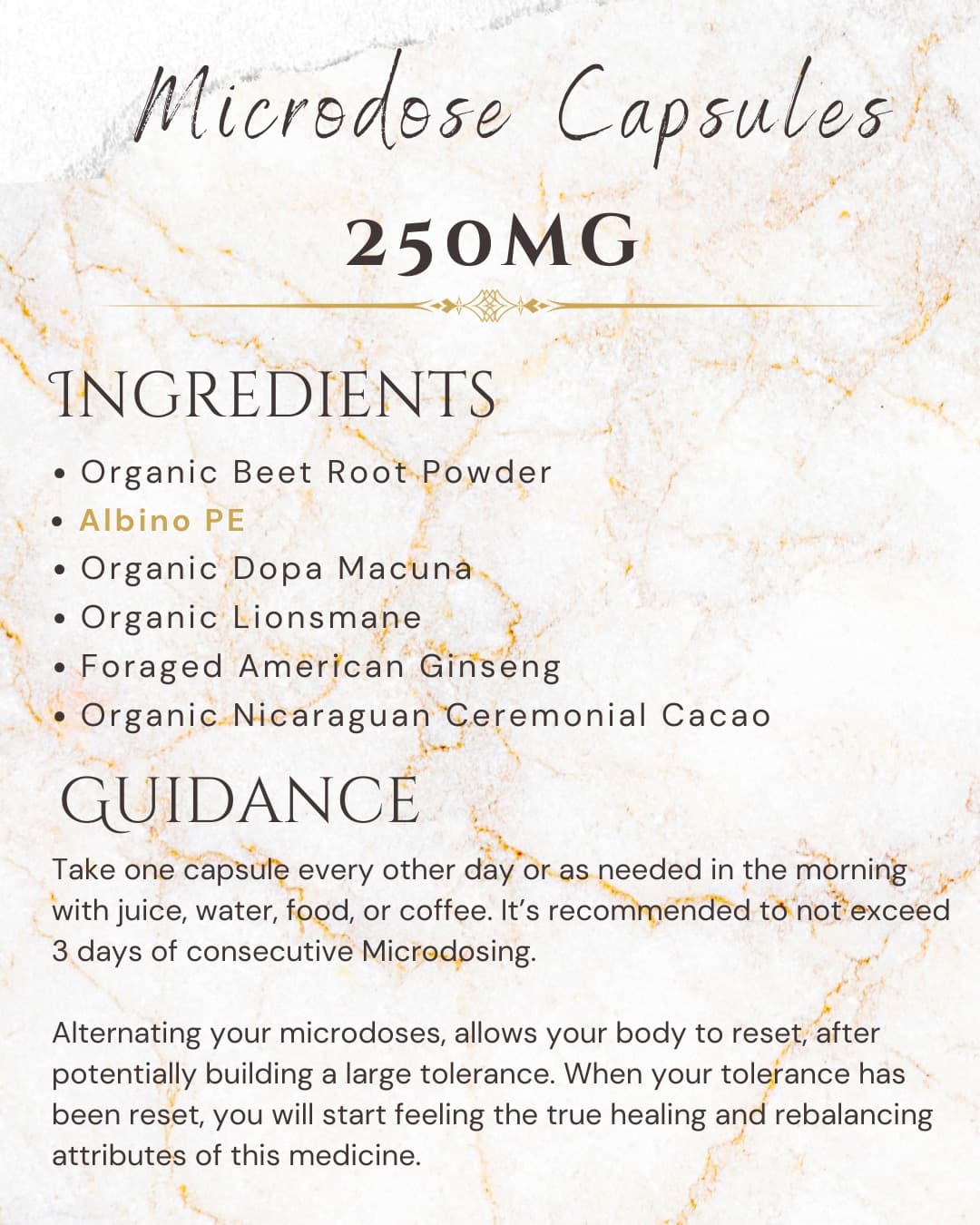
Day 1 (Dose Day): Take your microdose first thing in the morning (our Serenity capsules at 250mg are ideal). Within 30-60 minutes, many people report a subtle shift in perception — colors seem slightly more vivid, music sounds richer, and ideas flow more freely. This is the ideal window for creative work: brainstorming, writing, design, music, or any open-ended problem-solving.
Day 2 (Afterglow Day): No dose, but residual benefits are often felt. Many microdosers report that Day 2 is actually their most productive day — the neural connections formed on Day 1 are still active, but without any perceptual shift at all. Great for both creative and analytical work.
Day 3 (Baseline Day): No dose. Return to your normal baseline. This rest day is important for preventing tolerance buildup and allowing integration of any insights from the previous days.
Repeat the cycle.
## Real-World Creative Applications
Writing & Content Creation: Microdosers frequently report enhanced ability to enter 'flow state' — the psychological condition of total absorption in a task. Words come more easily, connections between ideas feel more natural, and the inner critic softens.
Visual Art & Design: Enhanced pattern recognition and color sensitivity are among the most consistently reported effects. Designers report seeing compositional relationships they would normally miss.
Music Production: Many musicians describe increased emotional sensitivity to sound and enhanced improvisational ability. The 'gap' between having an idea and executing it feels shorter.
Problem Solving & Strategy: Entrepreneurs and product managers report that microdosing helps them see familiar challenges from entirely new angles — the essence of strategic innovation.
## Starting Your Creative Microdose Practice
Our recommendation for creative professionals:
1. Start with Serenity Capsules (250mg) — precisely dosed for reliable, consistent experiences 2. Follow the Fadiman Protocol (dose every 3rd day) for at least 4 weeks before adjusting 3. Keep a creativity journal — note ideas, mood, energy, and creative output on dose vs. non-dose days 4. Schedule creative work for mornings on dose days — this is when divergent thinking is most enhanced 5. Don't force it — microdosing works best as a gentle catalyst, not a productivity hack
---
References: Prochazkova et al., Psychopharmacology (2018); Polito & Stevenson, PLOS ONE (2019); Anderson et al., Psychopharmacology (2019); Mason et al., Translational Psychiatry (2021).